How much paint do I need?
In this guide, we’ll walk you through the process step by step and highlight what many people tend to overlook. That way, you can tackle your painting project with confidence and the right amount of paint in the bucket.
How to calculate how much paint you need
When figuring out how much paint you’ll need for a room, it really just comes down to measuring the surfaces you want to paint and then dividing that by the paint’s coverage rate. It might sound technical, but the process is pretty simple when you take it step by step. Here’s how:
1. First measure the surfaces in meters
Are you painting walls? Then measure the length of each wall, add the numbers together, and then multiply the total by the height from floor to ceiling ((wall + wall + wall + wall) x the height of the walls in meters).
If you’re painting the ceiling, measure the length and width and multiply the numbers together (length x width). The same applies if you’re also painting the floor (length x width).
When you do these calculations, you’ll get the total wall area in square meters.
2. Determine the paint’s coverage
Next, you need to determine how much that specific paint covers. This will help you figure out how much paint you’ll need for your painting project. It’s therefore a good idea to identify the exact type of paint before you buy, since you’ll need to know its coverage in advance.
The can always states how many square meters one liter of paint covers. Many types cover around 6–10 m² per liter per coat. If you need to apply two coats—as most people do—be sure to factor that into your calculation. It makes a big difference in how much paint you’ll end up needing.
3. Calculate the total amount of paint
Once you have both the area and the coverage, divide the area by the square meters per liter. This will tell you how many liters of paint you’ll need per coat.
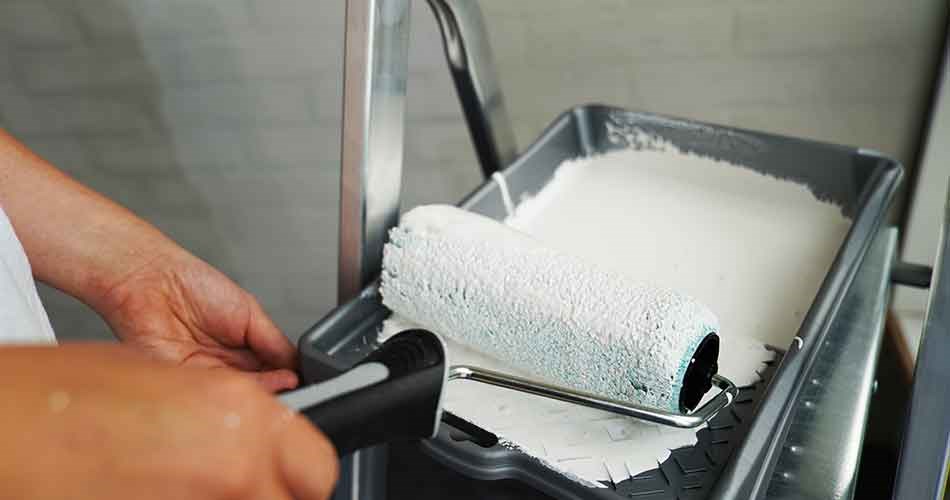
An example:
You need to paint a room where the walls together measure: (4 + 3 + 4 + 3) x 2.4 m = 33.6 m². If the paint covers 8 m² per liter, that gives: 33.6 / 8 = 4.2 liters per coat.
If you need to apply two coats, you’ll need about 8–9 liters in total.
Using this method, you will quickly get an accurate idea of how much paint you need to buy—and avoid running out of paint right in the middle of the job.
Keep this in mind when calculating how much paint you’ll need
Although it seems simple to figure out how much paint you’ll need, there are several small details that many people overlook. These can quickly make the difference between having enough paint—or finding yourself in the middle of the job and needing another liter.
One of the biggest mistakes is that many people only plan for one coat of paint. Most walls actually require two coats for proper coverage, and if you’re painting from dark to light, you might even need three or four. This, of course, affects how much paint you’ll need in total.
Another thing many people forget is the ceiling. That can easily add up to an extra 10–15 m², which quickly requires a liter or two. The same goes for doors, door frames, and paneling if they need a fresh coat—especially if they’re painted with a different sheen than the walls.
The surface is also important. New drywall and porous surfaces absorb far more paint than walls that have been painted before. If you don’t account for this, you’ll often end up needing an extra bucket. A primer can actually help you save paint because it seals the surface.
Finally, there’s the measurement. Many people guess the room size or round down, and then the calculation quickly becomes too optimistic. That’s why it’s a good idea to pull out the measuring tape or folding ruler, even if it seems like a hassle. It takes two minutes and gives you a much more accurate picture of how much paint you’ll need, and in the long run, it can really pay off.
By avoiding these common mistakes, you’ll be much better equipped to buy the right amount from the start.