How to charge a car battery step by step
When should a car battery be recharged?
A car battery often shows signs of weakness before it is completely flat. If you notice that the car is slow to start, or that the engine sounds sluggish when you turn the key or start the car, this may be a sign that the car battery needs recharging.
If you only hear a clicking sound when you try to start the car, the battery is often so flat that it cannot turn the starter motor. The same applies if the car’s lights seem dimmer than usual, or if the dashboard is not as bright.
If the car has been stationary for a long time, the battery may also lose power, and it may be time to recharge it. This is particularly true in winter, when the cold affects the battery’s performance. Low temperatures make it harder for the battery to supply power, which is why many people experience problems during the cold months. If you notice these signs, recharging the battery is usually enough to get the car running again.
What you need to charge a car battery
Before you start charging your car battery, it’s a good idea to have the right equipment ready. The process itself isn’t particularly complicated, but it’s important to do it correctly and safely.
You’ll need the following to charge a car battery:
- Battery charger: A charger that is suitable for your car battery. Most modern chargers are easy to use and regulate the current automatically. See our range of battery chargers here.
- Gloves: Not essential, but a good idea to protect your hands from dirt and any sparks. See our range of work gloves here.
- Good safety goggles: Can provide extra protection if you are working close to the battery.
- Access to a power supply: You will need a power socket nearby, unless you are using a special type of charger.
- The car’s owner’s manual: Here you can check if there are any specific recommendations for your car.
- Check the battery type: If it is an AGM battery, make sure to set the charger to AGM. They require a slightly higher voltage (around 14.7 V) to function optimally.
Once you have everything ready, you are well prepared to proceed with charging the car battery.
How to charge your car battery: Step by step
Charging a car battery is usually quite straightforward if you take your time and follow the steps. Here is a simple step-by-step guide you can use at home.
- Switch off the car completely before charging the car battery: Make sure the car is switched off, the key has been removed, and all electrical equipment (lights, radio, etc.) is switched off.
- Locate the battery: The car battery is often located in the engine compartment, but in some cars, it may be in the boot or under a cover. Open the compartment and locate the battery so you can access the terminals.
- Check the terminals (+ and -): The battery has a positive terminal (+) and a negative terminal (-). These are usually clearly marked, and the positive terminal is often marked with a red plastic cap.
- Connect the clamps correctly: Always start with the positive terminal: attach the red clamp to the positive terminal (+). Then attach the black clamp to the negative terminal (-). Ensure that the clamps are securely fastened and cannot slip off. The most important thing is not to mix up the positive and negative terminals, as this can cause problems for both the battery and the charger.
- Plug the charger in: Once the clamps are correctly attached, you can plug the battery charger into the socket. It is important to do this last, as this reduces the risk of sparks when working on the terminals.
- Select the correct charging setting: Many chargers select the setting automatically, but some have different settings. Choose the one suitable for a car battery (and preferably ‘normal’ or ‘slow charge’ if in doubt). Check the car’s manual if you want to be sure.
- Wait and keep an eye on it: Let the car battery charge and keep an eye on the charger whilst it is charging. It is normal for charging to take time, especially if the battery is very low. Avoid leaving it to charge unattended for long periods if your charger is not automatic.
- Disconnect in the correct order: Once charging is complete, switch off the charger first and unplug it. Then remove the black clamp from the negative (-) terminal and finally the red clamp from the positive (+) terminal.
By following this sequence, you make charging the car battery both safe and straightforward, and you avoid the most common mistakes along the way (we’ll look at these in more detail later in the article).
Does your car have a start/stop system? If you have a newer car with a BMS, please note that it is better to attach the black negative terminal to a solid metal part of the car’s chassis rather than directly to the battery terminal. This way, the car’s control unit will detect that the battery is being charged, and you’ll avoid any strange error codes afterwards.
Does the battery need to be removed, or can it be charged in the car?
In most cases, a car battery can be charged whilst it is still in the car. Modern battery chargers are designed to be gentle, and most newer cars can easily cope with the battery being charged in this way.
However, if you have an older car, it may be a good idea to check whether the manufacturer recommends removing the battery whilst charging it. The same applies if the car has sensitive electronics or special systems.
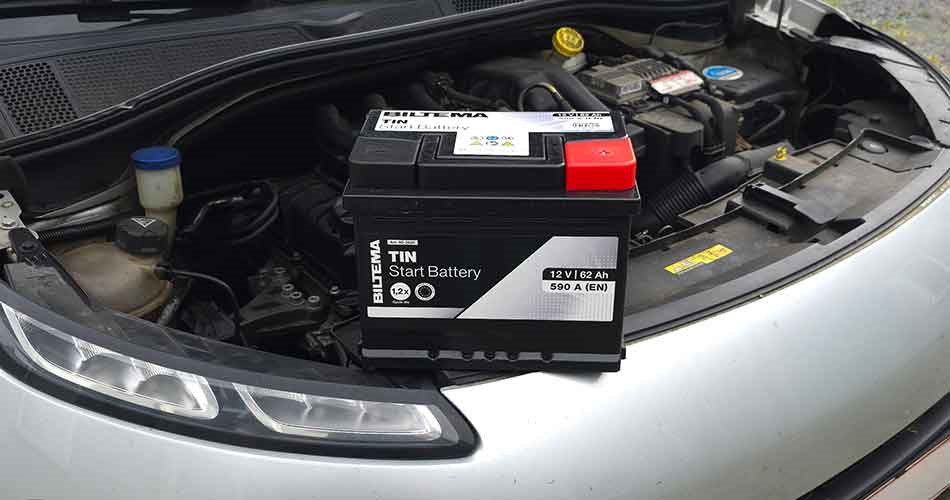
Always check your car’s owner’s manual if you’re in doubt. It should state the recommended procedure for your specific model when charging the car battery. You should consider removing the battery if it is very low, if there is visible damage, or if you intend to charge it indoors. In most normal situations, however, it is both easy and safe to leave the battery in the car when charging it.
How long does it take to charge a car battery?
The time it takes to charge a car battery depends on several factors. First and foremost, the battery’s capacity plays a role. A larger car battery usually takes longer to charge than a smaller one. It also matters how flat the battery is. If it is only partially flat, it can be ready again in a few hours. If it is completely flat, charging the car battery can take considerably longer.
Many battery chargers offer both fast charging and standard charging. Fast charging can get your car up and running more quickly, but a slower charge is often gentler on the battery. You’ll probably need to arm yourself with a little patience – it will certainly benefit you in the long run. If you give the car battery time to charge fully, it can help extend its lifespan and ensure that the car starts the next time you turn the key.
When should the car battery be replaced?
A car battery typically lasts between three and six years, depending on usage and driving habits. If you make a lot of short journeys, or if the car has been left stationary for periods of time, its lifespan may be shorter. If the battery has been completely discharged several times, it may lose some of its capacity. This means it will run out of power more quickly, even after being recharged.
If the car still won’t start, even though the battery has been properly recharged, this may be a sign that it is nearing the end of its life. The same applies if you can see visible damage, cracks or leaks on the battery. In such cases, it is often more sensible to replace the battery rather than attempt another charge. Read our guide: “Car Battery Guide – Which battery fits my car?”. This will help you find the right car battery for your vehicle. You can also always search using your registration number on our website.
Common mistakes when charging car batteries
Charging a car battery isn’t difficult, but there are some mistakes you should avoid ensuring it’s done safely and correctly:
- Reversing the positive and negative terminals: If the clamps are attached incorrectly, it can damage both the battery and the charger.
- Disconnecting in the wrong order: Always switch off the charger first, then remove the negative terminal before the positive.
- Charging without supervision: Older chargers should not be left switched on for long periods without supervision.
- Charging a faulty battery: If the battery is cracked or leaking, it should not be charged.
- Ignoring warnings: If an error indicator lights up on the charger, you must stop and check the cause.
By following the instructions and taking your time, you will avoid most problems and make charging your car battery both safer and more efficient.